

Do you need to consider floor levelling ?
Well the answer is not all that complicated, it all depends on the Product and what you want the finished job to look like.
When looking at Hard floorcovering finishes, the flatter/smoother the sub-floor finish the longer it will service your needs and the appearance of your job will serve you for many years.
Floor Levelling under Carpet:
The sub-floor under carpet need not be as perfect as that required under a Hard floorcovering as in a Comcork, Vinyl or other hard finished products that are adhered to or take on the shape of your sub-floor, to calculate the bag quantity of Ardex levelling cements and costs to expect use our cement levelling cost calculator below.
As an example, lets say you are going to install a smooth finish vinyl floorcovering and you may think that you have a reasonably level looking concrete/sub-floor, the first thing you need to understand is, if have any windows or bright lights that casts light across that area, a slight imperfection will be far more visible once your product is installed, especially if you seal a product like Comcork Polly-Cork flooring with an anti-slip wet-look finish or Rubber & Polly flooring for that matter.
It is very important to use the correct primer when installing cement levelling compounds.
These are the three main sub-floor types;
 |
1/ A very porous concrete/cement sub-floor, will need to apply two coats of Ardex-51 primer (data sheet) or equivalent, the first coat should be a 1:3 mixture with water and applied with a fine bristle broom or roller if not to rough a surface, allowing from 1~3 hours to fully dry, followed with a 1:1 mixture & allowed to dry again, this will leave the a slight gloss atop the concrete. Priming & sealing this floor correctly will do 3 things; |
||
|
|||
NB: If bubbling starts to occurs then you should work the area (wearing cleated shoes) with a trowel or special spiked levelling roller, or you may have run a Carborundum stone (brick) over the bubbles if dry, and to re-coat over these mini air bubble craters with a feather finish product, and then reseal the area. 2/ If the surface you want to level is sound, smooth & non porous (eg. Terrazzo or over old ceramic tiles), then you will need Ardex P-82 primer (data sheet) or equivalent applied first, this will give the levelling compound a surface to bond to, you must not walk on the surface until the primer has dried correctly (Prior to spreading the cement levelling compounds). 3/ If the surface you want to level is, Mastic asphalt, badly sanded old mastic asphalt floors, Timber or Wooden particle board, you will need to use ARDITEX-NA Leveling/smoothing compound (data sheet) or equivalent, depending on how stable the sub-floor is, you may need to install an underlayment or mesh or fiberglass matting over the area and take particular attention to any flooring cracks or joins. |
.jpg)

Repairing, Ramping and Levelling floors:
We have repaired, ramped and levelled floors from one metre holes in the ground to floating and constantly moving boats with Steel and Aluminium buckled decking (Aluminium/Steel levelling compounds required abnormal amounts of flexibility after the product has set).
The average levelling thickness would be from 3~5mm and tapered off to a feather edge finish. Another common use is to take out, hair line cracks in old sub-floors and the old glue/trowel marks left from 50 year old floorcoverings, this is only done when installing a Hard floorcoverings.
NB: It is HIGHLY recommended to priming the surface BEFORE and AFTER the installation of ANY levelling compounds, as the Final prime will Slowdown/stop the glues/adhesives setting to fast, especially in hot weather, thus enabling the installer enough time to roll or bubble board out the fresh glue so as not to dry in ridges causing "Trowel marks".
Levelling Compounds:
Their are a multitude of repair and levelling products on the market today, we use "Ardex K-15" the most, for the hardest & strongest finished, and Dunlop produce is a generic product made by Ardex, so we use that more so for beneath Carpet & Planking!
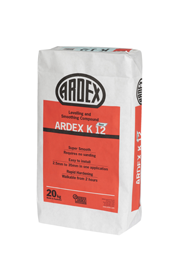
Products that stand out for Leveling, Ramping or Repair floors are, ARDEX K-15 (data sheet), Ardex K-12 (data sheet), Arditex-NA (data sheet), MAPEI, and UZIN, Dunlop, Davco, Durafloor, Hardman etc.

.png)
If you are levelling a sub-floor for Vinyl or other hard floorcovering, use any of the products above. NB: It is foolish not to first Vacuum, Prime & Seal the sub-floor prior to pouring Leveling cements, as there is a good chance they will separate with time, a final seal is always recommended, Both applications provide a stronger adhesion and water resistant finish. |
How much will it cost you to correctly prepared/repair float your sub-floor? Well, it may be as little as $3 per square metre (m2) up to as much as $60 m2 for specially developed flexible epoxy levelling compounds, installed over flexible Aluminium or steel or Timber substrate, it really just depends on the particular project.
Below calculator gives a good estimation of standard Leveling costs !

Our floor levelling, preparation, ramping or repairs costs, will be the same as the above costs !
The above Calculator saves both our time, as it asks the relevant questions relating to Leveling thickness.
Questions Not answered above, then use this levelling Quotation form, Sydney Region Only.
| HOME |  top of page top of page |